
Journal title view
Review of Scottish Culture
Founded in 1984, the Review of Scottish Culture (ROSC) is an international, fully peer-reviewed journal. It is supported by the European Ethnological Research Centre at the University of Edinburgh (EERC) and published by the University of Edinburgh.
ROSC encourages multi and interdisciplinary research with a focus on the ethnology of Scotland, tangible and intangible heritage. It welcomes submissions considering the culture of Scotland – both as it is expressed today and as it connects to the past and future.
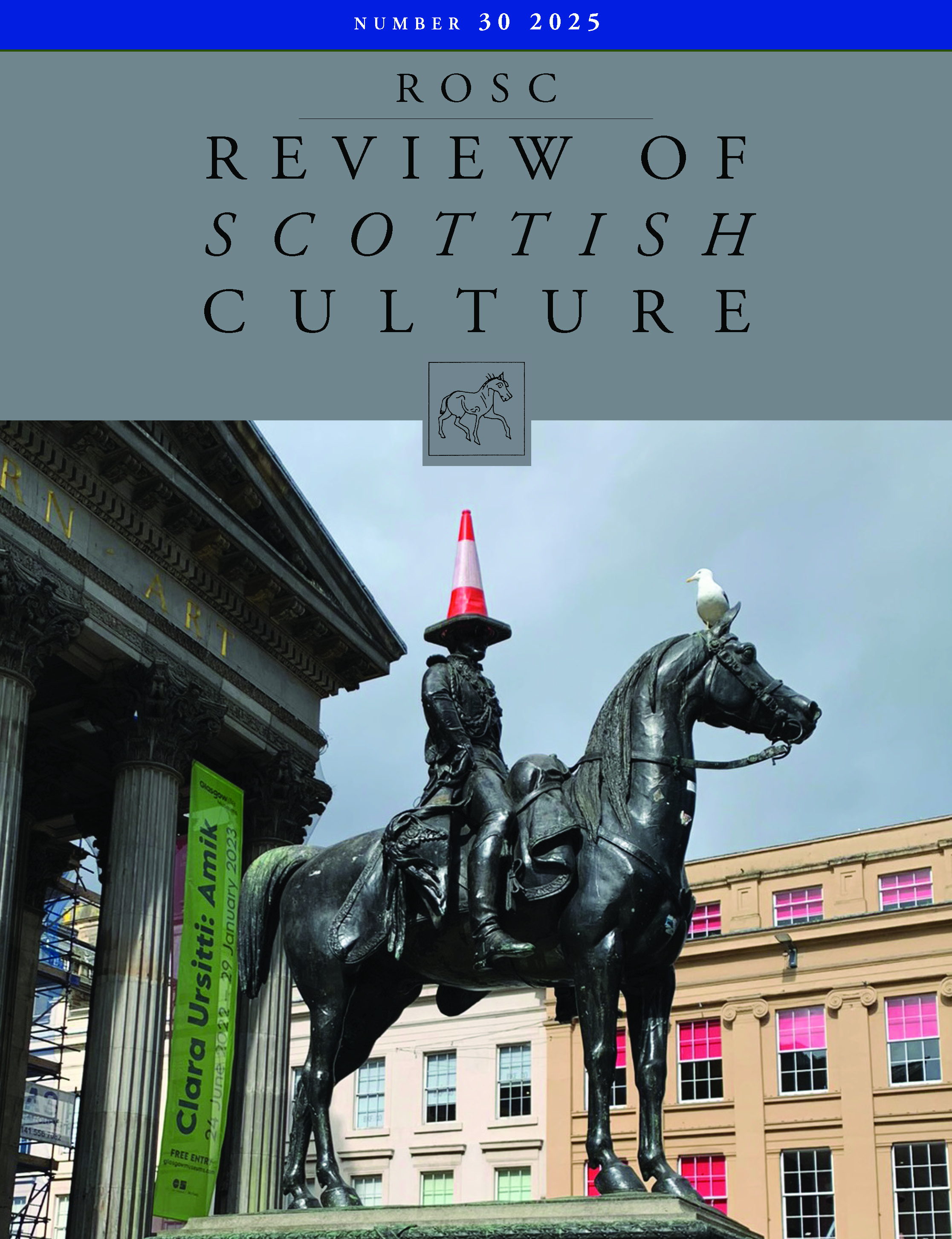
Journal information
- ISSN
- 2978-3658
- Owner
- Journal editor(s)
- Years available
- 2024 to 2025
- Year established
- 1984
- Subject areas
- Cultural Theory
- Languages
- English
- Licence
- CC BY
- Website
- The journal's site
- Catalogue record
- View in the catalogue
2020 – 2026
Articles, by year
- Citations Phase 2
- Articles
- Usage Phase 3
| Year | Articles |
|---|---|
| 2020 | 0 |
| 2021 | 0 |
| 2022 | 0 |
| 2023 | 0 |
| 2024 | 15 |
| 2025 | 13 |
| 2026 | 0 |
Where its authors are based
Countries of the institutions its authors were affiliated to when they published.
- AUTHORS
- CITATIONS Phase 2
- USAGE Phase 3
| Country | Authors |
|---|---|
| United Kingdom | 1 |
About this data
These figures cover 28 articles. Each value comes from the most trusted source that has it; a correction made by OJC staff outranks every source.
| Source | Confidence | Articles |
|---|---|---|
| OpenAlex | 70 / 100 | 28 |
| Articles with a publication date | 100% |
|---|---|
| Articles with a DOI | 100% |
| Articles with a funder recorded | 7% |
| Authors with an affiliation | 3% |
| Affiliations matched to an institution (ROR) | 100% |
| Affiliations with a country | 100% |
Countries come from the institution each author was affiliated to when they published, as recorded in ROR. A country is never guessed, so authors without a matched institution are not counted on the maps.
Funders come from OpenAlex for articles and Thoth for books, where publishers recorded them. Most articles record none, so a funder's figures show what is recorded, not everything it funded.
Citations (Phase 2) and usage (Phase 3) are not collected yet.